

How to Conduct Effective Medical Device Design Reviews
Design reviews are a mandatory part of medical device development and are often mistakenly treated as a compliance checkbox. When done properly, however, they can become a meaningful competitive advantage. This article explains why medical device design reviews matter and how to conduct them effectively—from what a design review is and who should be involved, to the review process itself and the common pitfalls to avoid.
Medical Device Design Review in a Nutshell
A design review is a formal, documented, system-level evaluation of a medical device’s design and development outcomes.
It assesses whether the results meet the established requirements and serves as a checkpoint to confirm the design is progressing as planned and remains safe and effective for its intended use.
Why Design Reviews are More Important Than You Think
Design reviews are critically important for two reasons: one official, and one unofficial—but very valuable.
First, the Non-Negotiable Reality: They’re Mandatory
Market submissions to the FDA, Health Canada, and other regulatory bodies require medical device manufacturers to conduct formal design reviews. This is not optional; it is a fundamental requirement for building a device that can be legally marketed.
- FDA: The FDA explicitly requires formal design reviews under regulation 21 CFR 820.30. This mandate is enforced through systematic inspections and has serious consequences for non-compliance.
- ISO 13485: This international standard for medical device quality management systems outlines the requirement in Clause 7.3.5, Design and development review. Compliance is enforced through a system of third-party certification, which is essential for market access in many regions.
Because of this regulatory pressure, design reviews are often viewed as just another box to check on a long list of procedural requirements. However, the most successful development teams use design reviews for far more than compliance—they treat them as powerful drivers of project success.
The practical benefits: building a better device
When done effectively, medical device design reviews deliver tangible benefits that improve both the development process and the final product. In fact, they can become a team’s competitive advantage by providing:
- Better project management: Design reviews keep development on track and ensure the entire team is aligned on progress, priorities, and unresolved issues.
- Enhanced collaboration & improvement: They create a structured opportunity for cross-functional teams to provide constructive feedback, drawing on diverse expertise to strengthen the design.
- Risk mitigation: Reviewing the design at key milestones helps teams catch issues early—before they become deeply embedded and expensive to fix. Resolving a flaw in a meeting is far cheaper and faster than correcting it after tooling is cut or prototypes are built.
- Increase stakeholder confidence: For both internal leadership and external clients, a rigorous design review process provides visible proof of progress. It shows the device is on a clear, controlled path to market, building trust and confidence in the project’s success.
That said, this process is only as effective as the team assembled to execute it.
Who Should Be Involved in a Design Review
A successful design review depends on having the right mix of expertise and perspectives in the room. A well-rounded team enables a thorough, objective evaluation of the device design. Key participants typically include:
- Cross-functional representatives: Team members from all relevant functions involved in the design stage being reviewed, including participants from both the development firm and the client.
- The independent reviewer: An objective individual who is not directly involved in the design stage being reviewed, providing an unbiased perspective as required by the FDA. This reviewer may come from the development firm, the client organization, or an external advisory role.
- Specialists: Subject matter experts brought in for their specific knowledge of certain aspects of the device, as needed. This is often a representative from the client team.
Once the appropriate stakeholders are identified, the focus shifts to a disciplined, three-phase process designed to maximize efficiency and impact.
The Design Review Process: a Three-Phase Approach
A medical device design review is not a single meeting—it is a structured process designed to ensure discussions are productive and that identified issues are formally resolved. This three-phase approach prevents reviews from becoming aimless conversations and ensures insights lead to concrete actions.
Phase 1: preparation (before the meeting)
Thorough preparation is key. The goal is for every participant to arrive informed and ready to contribute.
Agenda brainstorming
Who: SE/ID/DE/EE
Technical team members brainstorm potential agenda items for the Design Review Record.
Finalize and distribute
Who: PM (+SE)
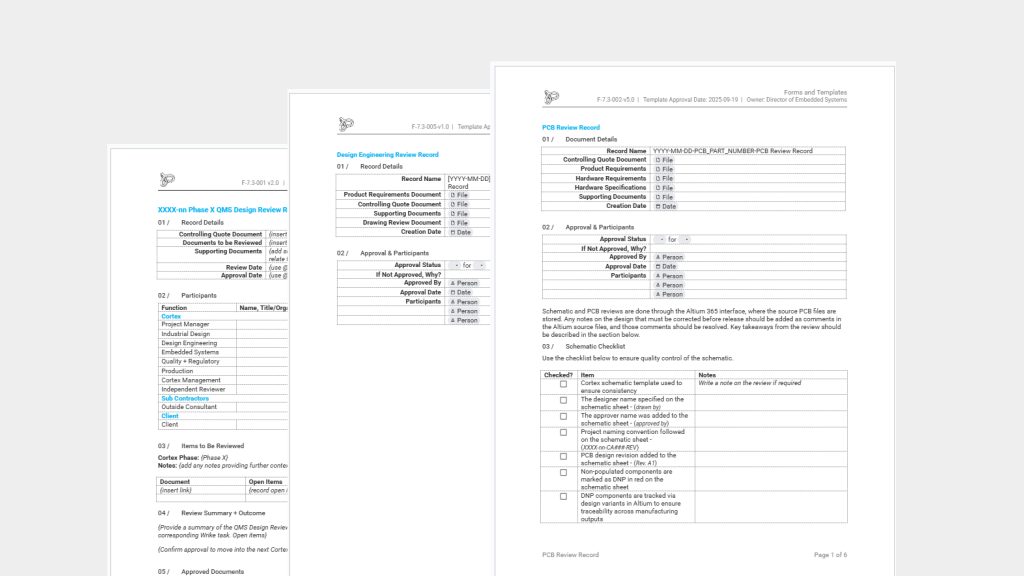
The Project Manager, in collaboration with the Systems Engineer, finalizes the Design Review Record. This includes a detailed agenda and all documents to be reviewed, which are distributed to the client at least one week before the meeting.
Phase 2: the review (during the meeting)
This phase is the collaborative core of the process, where the team formally evaluates the design against its requirements.
Moderation
Who: PM
The Project Manager facilitates the session, keeping the discussion focused on the agenda and directing questions to the appropriate team members. Key details are formally recorded, including the date, a list of all attendees, and all documents reviewed. Meeting minutes are taken to capture the discussion.
Technical discussion
Who: SE/ID/DE/EE
The Technical team members discuss their work according to the items outlined in the agenda. As discussions progress, the team identifies clear, actionable tasks to address any issues or gaps identified during the review.
Phase 3: follow-up (after the meeting)
The true value of a medical device design review is realized in this final phase, where discussion is translated into tangible improvements. “The output of a review is action, not just discussion.”
Closing the loop on every action item is essential. An unresolved action item represents an unmitigated risk or an uncorrected design flaw that remains in the project.
Implement & revise
Who: SE/ID/DE/EE
Technical team members address assigned action items and update the relevant design documentation to close the loop.
Update the record
Who: PM (+SE)
The Project Manager and Systems Engineer update the Design Review Record, documenting the status of all action items and noting any that remain open. The finalized record is then sent out for approval.
How Often Should You Have a Design Review?
Design reviews should be scheduled in alignment with major project milestones—typically at the end of each design phase, or when necessary within a phase (eg, pre- and post-prototype release). The rationale behind this cadence is simple: each design review serves as a formal “checkpoint” to confirm that the design meets its requirements before the team commits resources to the next stage of development. This ensures that the project is progressing according to plan and that the device remains safe and effective at every critical juncture.
Where Medical Device Design Reviews Go Wrong — and How to Correct Them
Ultimately, the goal is to move beyond compliance to use design reviews as a practical tool for building safer, more effective devices. To achieve this, it’s helpful to remember not just what to do, but what to avoid.
Below are the most critical mistakes to watch for when planning and conducting design reviews:
Wrong attendeesInviting too many—or the wrong—people derails the review’s purpose. |
Include only essential contributors, with independent reviewers as needed. |
Lack of preparationNot sharing agendas or documents in advance, assuming full prior knowledge. |
Distribute the agenda and all relevant documents at least 3 days prior. |
Overloaded agendasCramming too much into a single review dilutes focus and causes fatigue. |
Limit scope and target a 60–90 minute duration. |
Agenda driftAllow “sidebar discussions” to derail the meeting. |
Prepare and stick to a clear agenda. Park sidebar discussions for follow-up outside the meeting. |
Infrequent reviewsLetting too much time pass increases project risk and makes reviews heavier. |
Conduct frequent reviews with a narrow, manageable scope. |
Poor documentationUndocumented reviews waste time and create compliance gaps. |
Record decisions, actions, and rationale for traceability and compliance. |
Key Takeaways for an Effective Design Review
The ultimate goal of the design review process is not merely to satisfy regulators, but to use it as a proactive, collaborative tool for building safer and more effective medical devices. Mastery of this process is a hallmark of a high-performing development team.
Here are the most critical principles to remember:
- The goal: Move beyond simple compliance to use reviews as a powerful tool for genuine device improvement and risk mitigation.
- The people: Always assemble a cross-functional team that includes an independent reviewer and specialists to ensure a comprehensive and objective evaluation.
- The process: Be prepared, manage time well, and conduct frequent, focused reviews with a narrow scope rather than infrequent, oversized ones.
- The follow-up: Ensure every action item is tracked until it is formally documented as closed. A review is not complete until its findings are resolved.